

Some days the modern office feels like a competitive sport in looking busy. The pings, the updates, the out-of-hours “quick thoughts.” We’ve confused movement with momentum - burning out, going nowhere … and doing it very, very quickly.
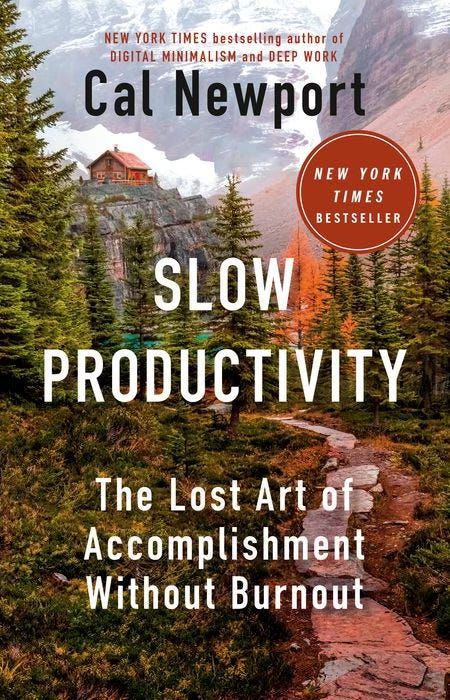
Cal Newport’s Slow Productivity arrived as a reminder of what most of us already know: that this constant motion isn’t getting us closer to good work—or to ourselves. He argues that we have never developed a good sense of what individual productivity actually means for the kinds of work that happen in words, images, ideas, and teams. It’s not as simple as counting widgets produced; emails per hour is a disastrous measure of professional effectiveness.
Newport’s suggestion sounds simple: do fewer things, work at a natural pace, and focus on quality. But in practice, this is both radical and really hard.
Radical because it’s difficult to measure and evaluate real productivity in knowledge work, so these suggestions imply a radical change in levels of trust and autonomy.
And it’s hard because there’s a system of behaviours that feeds off itself — busyness begets busyness. If a boss can’t tell who is actually productive, then who’s going to get the promotion? Telling your boss that your task list is full for the next two weeks sounds nice in theory, but would take some guts to put into practice in this context
This sets up a prisoner’s dilemma: the rational choice for any individual is to out-hustle everyone else, even though we’d all be better off if everyone slowed down.
And perhaps we have internalised this workplace culture — stillness can feel unsafe. If the emails and messages stop, how long is it before we start feeling like we’re irrelevant and disappearing? Out of the loop? Can we get through an afternoon of deep work without scratching our inbox itch?
So, if we could re-design work, what would we do to make it more human, meaningful and go with the grain of our psychology rather than against it?
To open up this question, we drew on our own experiences of making space for creativity. The limiting factor was rarely time - it was the right conditions: information, materials, briefing, mental clarity, freedom from distraction.
Often, our work habits work against us: The personal systems we build for managing our work matter as much as organisational ones. How do we handle our inbox? Track tasks? Allocate attention? These aren’t trivial housekeeping questions — they’re foundational to knowledge work, yet rarely given serious thought.
One of the areas we explored was around rhythm and texture in our work. Newport’s suggestion of “work at a natural pace” feels almost luxurious - and certainly better than cycles of zoom fatigue, burnout and rehab. Some of his tactics — longer time blocks, corralling admin, strategic calendar use — might help. But they have all been around for a while and on their own feel like marginal gains against a systemic problem.
We weren’t entirely satisfied. We wanted more of the big vision — how a modern workplace could be fundamentally different when designed around human effectiveness and wellbeing. We wanted bolder experiments, not just sensible adjustments. Above all, we wanted him to inspire us, grant permission, even start a movement.
But the most important part of our conversation was triggered by Newport’s instruction to “obsess over quality”. This struck us as deliberately provocative (obsession normally isn’t encouraged). We were more drawn to caring deeply about quality, which led us into thinking about what really matters in our field - what does quality really mean? We made distinctions between perfectionism and striving for excellence. The deliberately developmental process that refines taste and judgement.
This is the timeless wisdom this book reminds us of: the steady accumulation of excellence in your craft is an important form of productivity — one that is satisfying, meaningful, and very human. Perhaps that’s worth slowing down for.
If this resonated, here are some ways to explore Cal Newport’s ideas further:
It’s Time to Embrace Slow Productivity (New Yorker article) — The essay that laid the groundwork for the book (paywall)
Cal Newport: The Secrets of Slow Productivity (video interview) — 1-hour conversation with Ali Abdaal introducing the three principles
Slow Productivity visual summary (Sketchy Ideas) — Book overview using sketches by Chris J Wilson
The Surprising Math of Doing Less (video) — The author giving a 13-minute explanation of why doing less means achieving more